
Begin with Scripture
The Catholic case begins with Jesus’ Bread of Life discourse in John 6, the words of institution at the Last Supper, Paul’s teaching in 1 Corinthians 10, and his warning in 1 Corinthians 11 about profaning the body and blood of the Lord.
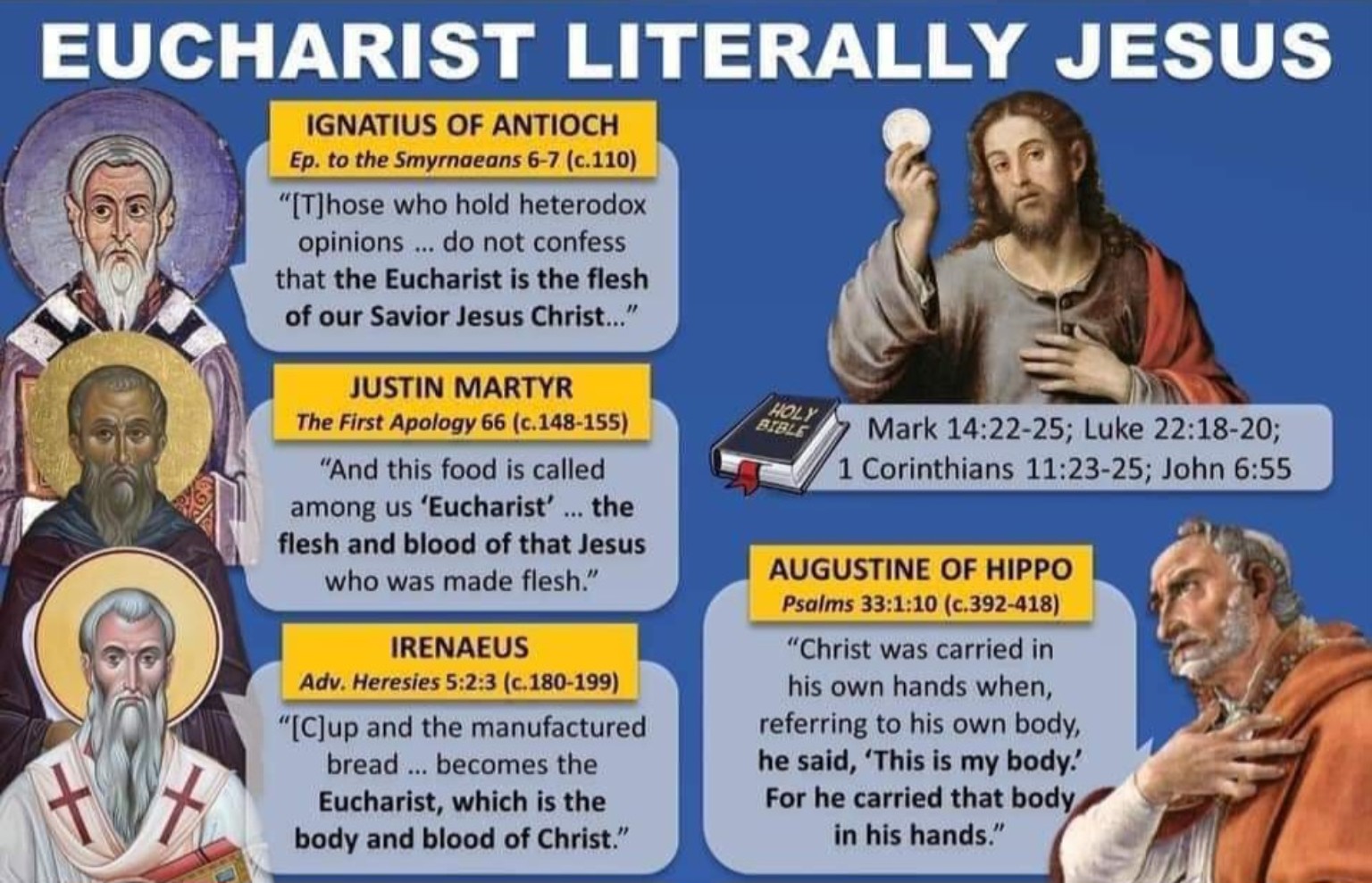
The Early Church
Ignatius of Antioch — c. A.D. 107
Ignatius was writing within living memory of the apostolic generation:
“They abstain from the Eucharist and from prayer, because they confess not the Eucharist to be the flesh of our Saviour Jesus Christ, which suffered for our sins, and which the Father, of His goodness, raised up again.”
— Letter to the Smyrnaeans 7
Ignatius isn't merely describing his own belief. He identifies the denial that the Eucharist is Christ's flesh as a characteristic of heretics. That is extraordinarily difficult to square with the idea that the earliest Christians understood Communion as merely symbolic.
Only decades after the New Testament
Justin Martyr — c. A.D. 155
“For not as common bread nor common drink do we receive these: but since Jesus Christ our Savior was made incarnate by the word of God and had both flesh and blood for our salvation so too, as we have been taught, the food which has been made into the Eucharist by the Eucharistic prayer set down by him, and by the change of which our blood and flesh is nurtured, is both the flesh and the blood of that incarnated Jesus.”
— First Apology 66
Justin is explaining Christianity to the Roman emperor, not engaging in obscure theological speculation. He's simply describing what Christians actually believe and practice. And this is only about 60–70 years after the last New Testament writings.
Watch: Jesus & the Jewish Roots of the Eucharist
Dr. Brant Pitre examines the Eucharist against its Jewish and biblical background, connecting the Last Supper with Passover, manna, and the expectations surrounding the Messiah.
A disciple of a disciple of John
Irenaeus of Lyons — c. A.D. 180
“He has declared the cup, a part of creation, to be His own Blood, from which He causes our blood to flow; and the bread, a part of creation, He has established as His own Body, from which He gives increase to our bodies.”
— Against Heresies 5.2.2
Irenaeus teaches that the bread and wine are really the Lord's body and blood, and his witness is all the more impressive because he produces it quite incidentally while refuting the Gnostic and Docetic rejection of the Lord's real humanity. He doesn't even need to argue for Real Presence—he simply assumes it as common Christian knowledge.
“The bread... having received the Word of God, becomes the Eucharist, which is the body and blood of Christ.”
— Against Heresies 5.2.3
Irenaeus was a disciple of Polycarp, who had personally known the Apostle John. That puts this testimony remarkably close to the apostolic generation.
More videos
How explicit can it get?
Cyril of Jerusalem — c. A.D. 350
This one is almost impossible to make more explicit:
“Consider therefore the Bread and the Wine not as bare elements, for they are, according to the Lord's declaration, the Body and Blood of Christ.”
— Mystagogical Catechesis 4.6
And then:
“The seeming bread is not bread, though sensible to taste, but the Body of Christ; and... the seeming wine is not wine... but the Blood of Christ.”
— Mystagogical Catechesis 4.9
Does this sound like symbolic interpretation? Cyril anticipates essentially the exact objection: But it still looks and tastes like bread and wine. His answer is explicitly to trust Christ's declaration rather than the senses.
Defending the Eucharist — Steve Ray
How Does the Manna Prefigure Christ? — Joe Heschmeyer
More on the Real Presence
The objection answered directly
Ambrose of Milan — c. A.D. 390
“Perhaps you will say, ‘I see something else, how is it that you assert that I receive the Body of Christ?’”
Ambrose answers:
“Let us prove that this is not what nature made, but what the blessing consecrated, and the power of blessing is greater than that of nature, because by blessing nature itself is changed.”
— On the Mysteries 9.50–51
Ambrose doesn't merely affirm the Real Presence. He directly addresses how ordinary bread can become Christ's body and appeals to God's power to change what something is.
What if it's not just a symbol?
Are Catholics Consistent?
Questions worth asking
Why does Paul call the cup and bread a participation in Christ’s blood and body? Why does he warn that receiving unworthily makes a Christian guilty concerning the body and blood of the Lord? And when the earliest Christians wrote about the Eucharist, did they speak as though it were merely symbolic?